
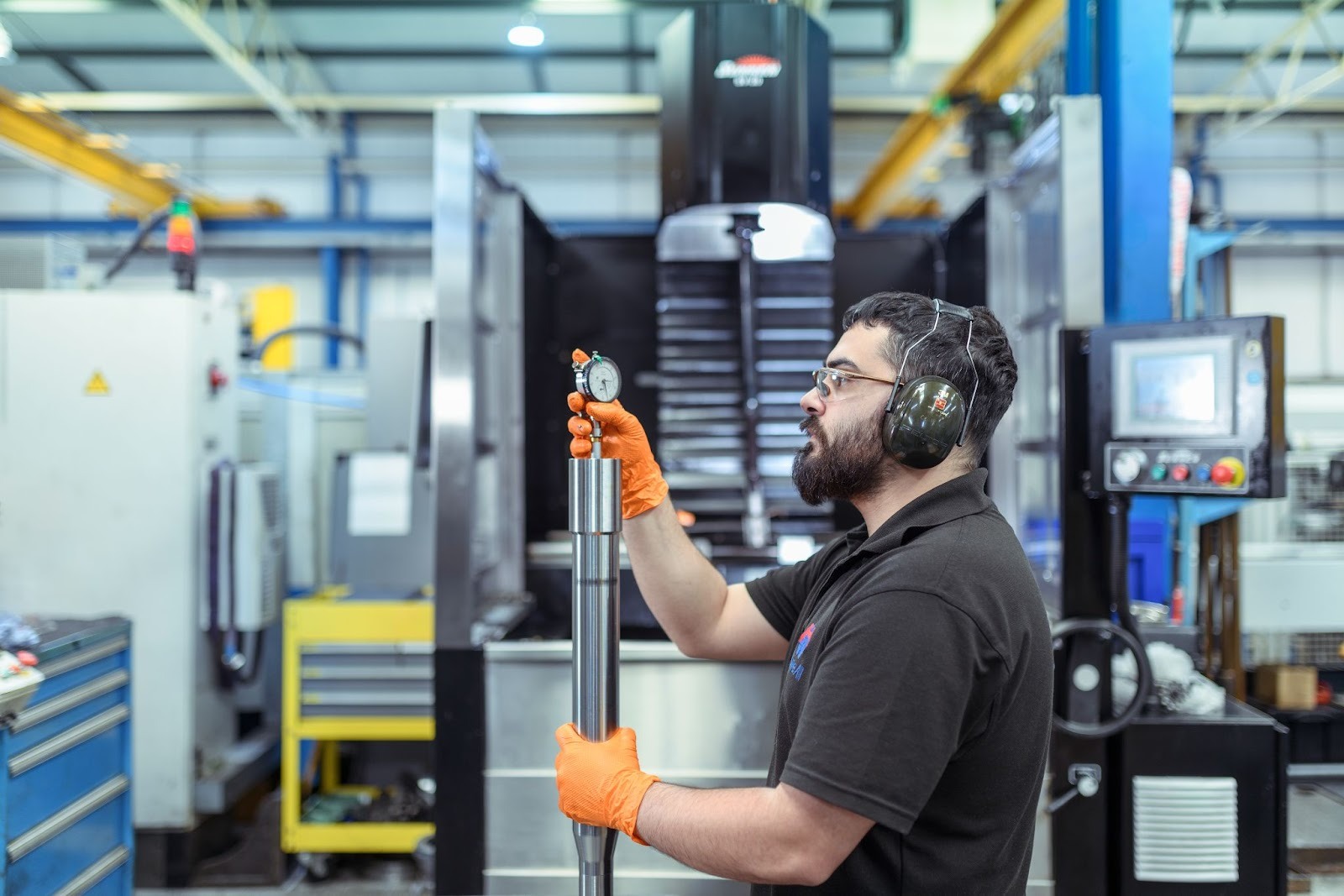
Drilling deep holes is not simply a matter of using a longer drill.
As hole depth increases, the process becomes far more difficult to control and requires specialist equipment to achieve consistent results. Heat builds quickly, tools are more prone to deflection, and swarf removal becomes increasingly challenging. Without careful control, it is easy for bore straightness, surface finish, and dimensional accuracy to suffer.
To produce a straight, accurate, and clean bore at depth, every aspect of the deep hole drilling process must be properly planned and tightly controlled.
When Does A Hole Become A Deep Hole?
In general engineering, a hole is generally classed as a deep hole when its depth reaches ten times its diameter. Beyond this point, conventional drilling methods typically begin to struggle. Coolant becomes less effective at reaching the cutting edge, and chips no longer evacuate cleanly from the bore. As a result, tool wear increases and maintaining bore accuracy becomes more difficult.
At this stage, specialist deep hole drilling techniques and equipment are required to maintain control and achieve reliable machining results.
Key Requirements For Successful Deep Hole Drilling
Accurate deep hole drilling depends on carefully controlling several critical factors. Each plays an important role in maintaining bore quality, straightness, and repeatability.

Tool Stability
Utilising bespoke whip guides and tool management ensures the drill is supported as it advances through the material. These stabilise the drill shaft and cutting action by reducing vibration and limiting tool deflection. Proper tool guidance is essential for maintaining bore straightness over long depths, particularly when working to tight tolerances.
Consistent High Pressure Coolant
Internal high pressure coolant delivery is critical in deep hole drilling. Coolant cools the cutting edge and assists with continuous swarf removal throughout the drilling process. If coolant pressure is insufficient, heat can build rapidly, leading to poor surface finish, increased tool wear, and potential bore damage. A powerful, stable and well controlled coolant system is therefore essential for deep hole machining.
Purpose Designed Deep Hole Tooling
Specialist tooling such as carbide tipped gun drills and BTA drills are specifically designed for deep hole drilling applications. These tools deliver coolant internally and incorporate dedicated chip evacuation paths to reduce the risk of blockages. Their design provides improved stability and process reliability, even when drilling to significant depths.
Correct Cutting Parameters
Feed rates and spindle speeds must be carefully controlled during deep hole drilling. Correct parameter selection helps minimise drill wander, reduces vibration, and produces a smoother, more accurate bore finish. While these settings differ from conventional drilling, they are essential for achieving consistent and repeatable results in deep hole applications.
Why Standard Drilling Machines Are Not Suitable
Standard drilling machines are rarely designed to cope with the demands of deep hole drilling. They often lack the rigidity, alignment accuracy, and coolant delivery capability required for long depth machining. For this reason, many manufacturers choose to work with specialist subcontractors such as Hone-All when deep holes and tight tolerances are involved.
Using dedicated deep hole drilling equipment helps ensure consistent quality, reduced scrap, and improved machining reliability.
Deep Hole Drilling At Hone All
At Hone All, we have over 30 years of experience and a wide range of dedicated deep hole drilling machinery to deliver accurate and repeatable results across a wide range of diameters and materials, and for all industries.
Our processes are designed to ensure minimised drill wander, ensure excellent surface finishes, and achieve tight tolerances, even at significant depths. This allows us to support demanding applications where accuracy and consistency are critical.
For more advice or further details on our deep hole drilling and other specialist machining services such as deep hole boring, honing and CNC turning, please contact us at sales@hone-all.co.uk